Navarro and Di Nenno: What to Expect from the New Pair in 2026
Paquito Navarro and Martín Di Nenno are reuniting after nearly four years apart. The pair has the credentials to compete near the top — but how high their ceiling sits in a 2026 circuit that is harder to crack than ever remains an open question.
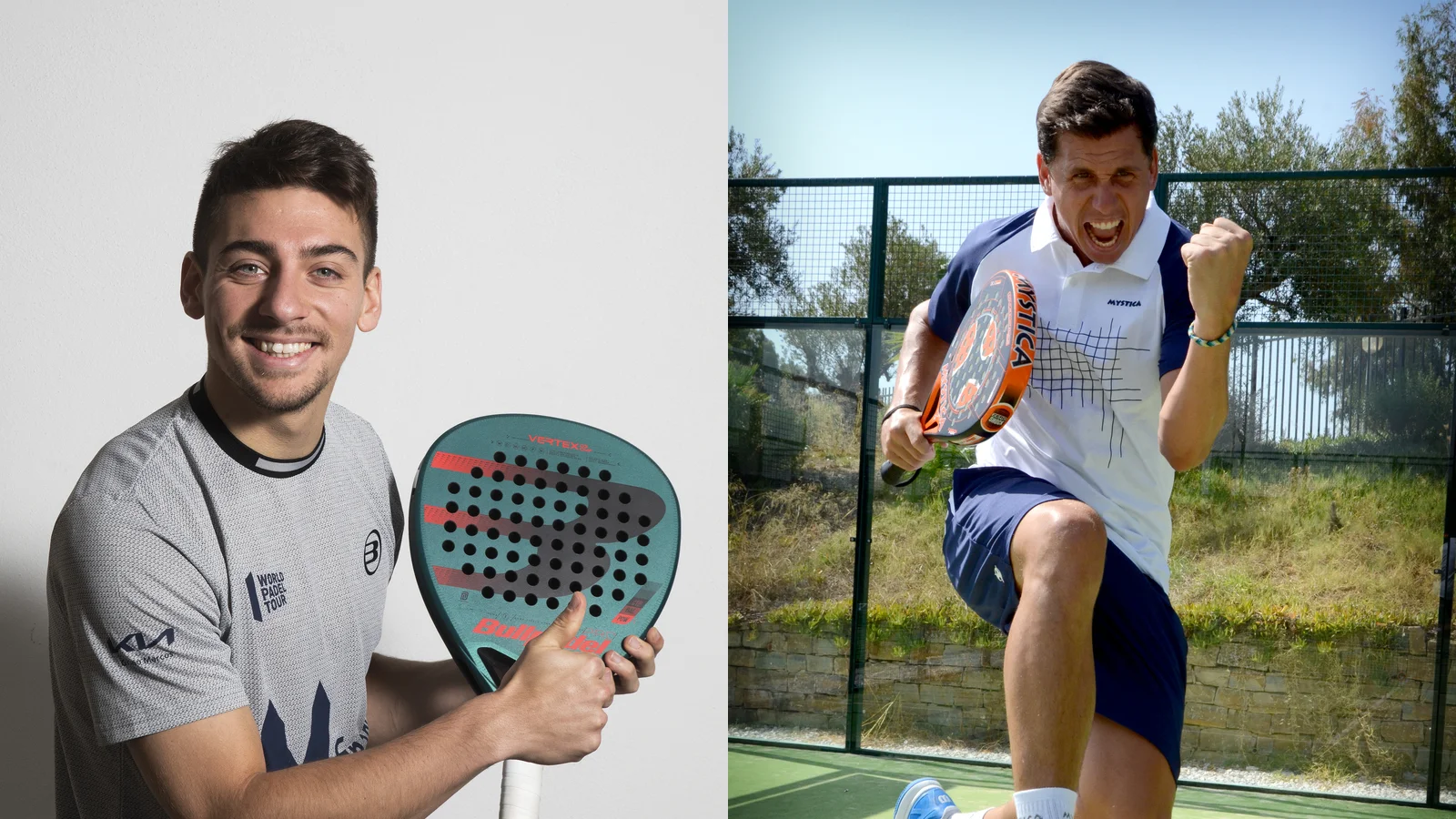
The announcement came on April 25, confirmed through @padelcerveza and reported by Marca: Paquito Navarro and Martín Di Nenno are joining forces again. Their debut is scheduled for the Italy Major in Rome on June 1, 2026. The reunion of a pair that won six titles together — including the first-ever Premier Padel Major — naturally invites optimism. But the relevant question is not whether they are capable. It is whether they can compete at the level the 2026 circuit now demands.
What They Already Did Together
The first stint ran from 2021 through October 2022 — one year and ten months of consistent results at the highest level. Navarro and Di Nenno won six titles during that period: five on the World Padel Tour — Córdoba 2021, Vigo 2021, Buenos Aires 2021, Barcelona Master 2021, and the Santander Cantabria Open 2022 — plus the Qatar Major 2022, which was the first Major ever contested under the Premier Padel banner.
At their peak they reached World No. 2 in the rankings, and in late 2021 they applied consistent pressure on the then-dominant pair of Lebrón and Galán in the fight for the top spot, without ultimately taking it. The partnership functioned on a clear stylistic basis: Di Nenno’s left-handed attacking game from the left side complementing Navarro’s experience and court intelligence from the right. Their coach throughout was Rodri Ovide.
The split in October 2022 was Di Nenno’s decision, attributed to a combination of competitive and personal burnout. That the relationship between the two players remained on good terms — as noted by AnalistasPadel — is part of what made this reunion viable in the first place.
The 2026 Circuit Is Different
The baseline established in 2021–2022, while impressive, no longer reflects the level required to win consistently. The pairs at the top of the 2026 standings represent a more demanding obstacle than anything Navarro and Di Nenno faced during their first run together.
Coello and Tapia hold the No. 1 position. Galán and Chingotto sit at No. 2 and lead the 2026 Race standings after winning both Newgiza P2 and Brussels P2. Stupaczuk and Yanguas, along with González and Lebrón, round out the upper tier of the men’s draw. This is a circuit with multiple pairs capable of winning Majors on any given week.
The rankings paint a clear picture of where Navarro and Di Nenno enter: Navarro is currently No. 8 with 6,295 points, and Di Nenno is No. 13 with 4,990, per the FIP standings dated April 27, 2026. As a pair, they will be slotted outside the top seeds at the outset, which means navigating a draw from a position that could produce early matches against established top-eight pairs.
Two Possible Readings
Media analysis published in the days following the announcement has divided broadly along cautious and optimistic lines.
Padel Magazine ES, writing on April 28, took a measured position. The outlet’s assessment framed the realistic objective as finding regular semifinals, competing for finals, and capitalizing on specific tournament opportunities where conditions align. For sustained top-four contention, Padel Magazine ES identified Navarro’s motivation at 37 as the primary variable. The logic is direct: if he enters 2026 fully committed, the pair is genuinely dangerous; if that commitment is partial or inconsistent, the ceiling is considerably lower.
PadelSpain, also writing on April 28, read the same situation with notably more confidence. Their view is that the pair “has all the ingredients to be a contender from the first tournament: experience, competitive character, and a complementary style that has already worked.” PadelSpain’s framing is grounded in the evidence of 2021–2022 — that the combination worked once, at a high level, and that the interpersonal foundation for it to work again is intact.
Both assessments have coherent foundations. The cautious reading acknowledges that age and motivation are factors that cannot be assessed from the outside. The optimistic reading points to the historical record and to a stylistic pairing that has demonstrated it can produce results. Neither position can be dismissed on the available evidence.
The Navarro-at-37 Factor
Paquito Navarro turns 37 in 2026. That number does not automatically limit what he can do — the professional padel circuit has examples of players performing at high levels past that age — but it does make consistency a more active concern than it would have been five years ago.
His results with Guerrero in the first part of 2026 offer relevant context. The pair lost in the quarters of Brussels P2, beaten by Galán and Chingotto 1-6, 0-6 — a scoreline that suggested something was significantly off on that day. Their best result in the period was reaching the semifinals at Riyadh Season P1. The overall pattern was inconsistency: a team with the quality to reach late rounds but without the solidity to do so reliably.
Di Nenno showed a similar pattern. His pair with Momo González recorded 10 wins and 6 losses in 2026, including a quarterfinal exit at Brussels P2, beaten by Bautista and Campagnolo 7-5, 6-4. They did win the FIP Gold Almaty in the earlier part of the season, which demonstrates Di Nenno’s capacity to perform at the top level — but the record as a whole is one of a pair that had not found a consistent gear.
The question is whether the reunion changes that. A new partnership, especially one with prior history and confirmed mutual respect, can reset momentum. Whether Navarro is physically and mentally prepared to commit to a demanding second-half calendar at the highest level is something only the results will confirm.
What the Next 12 Months Will Tell
The Italy Major in Rome on June 1 is the opening data point. As a Major — the highest-weight events on the calendar — it will test the pair immediately against the widest possible field. An early exit would not define the partnership, but a run to the semifinals or beyond would immediately validate the optimistic reading and generate genuine ranking points from a standing start.
The benchmark against which every result will be measured remains the same: Coello and Tapia and Galán and Chingotto. These are the pairs that have demonstrated the capacity to win at Majors consistently in 2026. To make a credible case for top-four status by the end of the season, Navarro and Di Nenno would need at least one deep run against that tier.
It is a high bar. The first stint shows they have the history to clear it. The 2026 standings and the strength of the current top pairs show why clearing it is not guaranteed.
Cover image: composition based on photographs of Martín Di Nenno by Gonzalo wim and Paquito Navarro by Charlypuff99. Wikimedia Commons, CC BY-SA 4.0.

